

- Your cart is empty
- Continue shopping
-
sonoriagr
- Posted on
- Categories:Eco Technology
- 0 comments
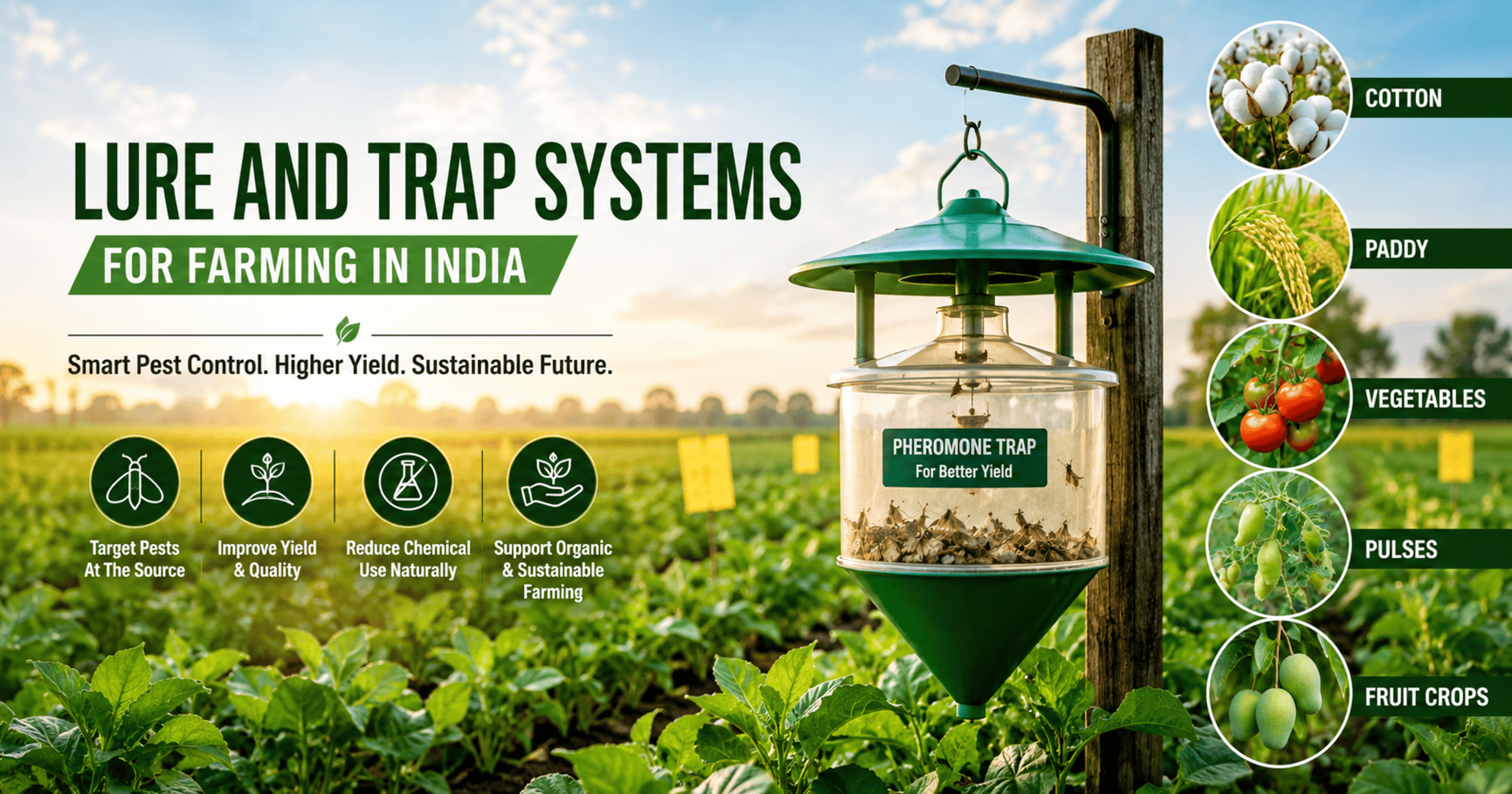
Pest damage costs Indian farmers an estimated Rs 90,000 crore every year in lost productivity. Of that, a significant proportion comes from a handful of moth and fly species that could be specifically targeted, intercepted, and removed from the field without a single drop of chemical spray. This is the core promise of lure and trap systems for farming in India precision pest control that works by exploiting the insect’s own biology against it, attracting it to a trap using either pheromone chemistry or visual cues before it can lay eggs, feed on the crop, or reproduce.
These systems have been in use across research farms and progressive commercial operations for two decades, but their adoption has accelerated sharply in recent years. Falling product costs, growing availability through domestic agritech suppliers, and rising demand for residue-free produce have all pushed lure and trap adoption from niche to mainstream. Cotton farmers in Vidarbha, paddy growers in Odisha, vegetable cultivators in Karnataka, and fruit orchardists in Himachal Pradesh are all using them for different pests, different crops, and different goals. This blog explains how these systems work, which crops and pests they cover, and how they translate into measurable yield improvement on Indian farms.
The Science Behind the Strategy: Why Lure and Trap Systems Work at the Source
How Pheromone Chemistry Turns Pest Biology Into a Trap
Pheromones are chemical signals that insects produce and release into the air to communicate with each other. In most agricultural pest species, females release sex pheromones to attract males for mating. Scientists have identified and synthesised these chemical compounds for dozens of economically significant pest species. When the synthetic pheromone is placed inside a lure dispenser and hung in a trap, it creates an irresistible chemical signal that draws male insects toward the trap from distances of up to 100 metres.
The male insects that enter the trap cannot escape. This is where the population dynamics become important. A male bollworm moth that enters a pheromone trap is one that will not fertilise dozens of females. Each unmated female will not lay the hundreds of eggs that would have become larvae burrowing into cotton bolls, chickpea pods, or tomato fruit. The intervention happens upstream of the damage, at the reproductive stage, which is where small numbers of trapped insects translate into large reductions in crop damage.
The Role of Funnel Traps, Delta Traps, and Sticky Inserts in Field Deployment
The physical trap that holds the pheromone lure is as important as the lure itself. Funnel traps are the most widely used design in Indian field conditions. The insect enters through a wide funnel opening at the top, falls through into a collection chamber at the bottom, and cannot climb back out. Funnel traps are durable, weather-resistant, and work well across the windy and rainy conditions of Indian monsoon season.
Delta traps, which use a triangular sticky insert inside the trap instead of a collection chamber, are preferred for monitoring applications where the goal is counting catch rather than mass trapping. A single delta trap with a pheromone lure gives a farmer a live, daily readout of pest flight intensity in their field, which is far more valuable for timing interventions than any calendar-based spraying schedule.
Crop by Crop: Which Indian Farming Systems Benefit Most From Lure and Trap Deployment
Cotton: The Highest-Stakes Application in Indian Agriculture
Cotton is India’s most chemically intensive crop, accounting for approximately 50% of total pesticide use despite covering only around 5% of the cropped area. The primary reason is bollworm pressure, particularly from the pink bollworm, American bollworm, and spotted bollworm, which can devastate yields across Maharashtra, Telangana, Gujarat, and Punjab in a single season.
Pheromone-based lure and trap systems for farming in India targeting bollworm species have shown in ICAR and state agricultural university trials that mass trapping, when deployed at the recommended density of 5 to 8 traps per acre, can reduce bollworm populations by 40 to 60% compared to untreated plots. Combine this with a targeted spray only when monitoring traps indicate population thresholds have been crossed, and cotton farmers can cut pesticide applications by 2 to 3 rounds per season without compromising yield protection.
Paddy and Maize: Managing Borers Across India’s Largest Cereal Crops
Yellow stem borer in paddy and fall armyworm in maize are two of the most damaging pests in India’s cereal belt. The yellow stem borer alone is responsible for 10 to 20% yield loss in paddy across Odisha, West Bengal, and Chhattisgarh in high-pressure years. Fall armyworm, an invasive species that entered India in 2018, has now spread across maize-growing states and is causing losses of up to 30% in unmanaged fields.
Both pests are effectively monitored and suppressed using species-specific pheromone lure traps. For paddy farmers, trap catches above 5 moths per trap per night serve as an early warning threshold that triggers targeted intervention, replacing the reactive and often late chemical applications that follow visible plant damage. For maize, fall armyworm lure traps provide the only reliable early detection system available to smallholder farmers.
Vegetables, Pulses, and Orchards: Pheromone Traps as the Organic Standard
Vegetables and pulses grown for domestic consumption and export are under the strictest residue scrutiny of any crop category. Maximum residue limits enforced by buyers in the Gulf, Europe, and Southeast Asia mean that a single detected residue violation can cost a farmer or exporter an entire consignment. In this context, pheromone traps for organic agriculture are not just a preference. They are a practical requirement for market access.
Tobacco caterpillar lure traps for brinjal, tomato, and leafy vegetable crops, combined with solar light traps for broader nocturnal pest management, allow vegetable farmers to manage pest populations continuously without any chemical spray application. This combination is increasingly becoming the baseline pest management standard for certified organic produce clusters across Karnataka, Maharashtra, and Tamil Nadu.
From Monitoring to Mass Trapping: Two Strategies, One Tool System
Using Traps for Early Warning and Pest Population Monitoring
The monitoring application of pheromone traps is often undervalued by farmers who think primarily in terms of killing pests. But monitoring is arguably the higher-value use. When 2 to 3 traps per field are deployed at the start of the growing season, they provide a daily quantitative measure of pest flight activity that no other method can match at comparable cost.
A cotton farmer checking his trap catch each morning knows exactly when bollworm flight intensity increases above the economic threshold. That information determines whether a spray application is justified on that particular day, at that particular population level, rather than following a fixed-calendar schedule. Farmers who switch to threshold-based management consistently report a reduction of 30 to 50% in the number of spray applications per season, which reduces input costs, preserves beneficial insect populations, and improves residue profiles on the harvested crop.
Mass Trapping for Active Pest Population Suppression
When the objective shifts from monitoring to suppression, the trap density increases significantly. Mass trapping for bollworm on cotton typically requires 5 to 8 funnel traps per acre deployed from the first week of crop emergence. At this density, the traps intercept a meaningful proportion of the adult male population before mating occurs, creating a measurable reduction in the next generation of larvae.
For crop productivity solutions in India, the combination of mass trapping with threshold-based residual spraying when populations exceed economic injury levels has become the gold standard recommended by progressive extension workers across cotton-growing districts. The approach costs more in trap materials upfront but delivers significant returns in reduced spray costs, better yield protection, and improved produce quality.
How Lure and Trap Systems Support Integrated Pest Management on Indian Farms
Lure and trap systems do not replace every other pest management tool. They are most powerful as part of an integrated pest management (IPM) strategy that layers complementary approaches:
- Pheromone lure traps: species-specific monitoring and adult male trapping of target moth pests
- Solar light traps: broad-spectrum nocturnal insect removal across the full pest community
- Sticky traps: daytime flying pest monitoring and early infestation detection
- Bio-pesticides: targeted application at economic thresholds for larval populations
- Crop rotation and habitat management: disruption of pest lifecycle continuity across seasons
When these layers work together, the result is a farming system that manages pest pressure continuously across the crop lifecycle without relying on a fixed calendar spray programme that treats fields whether or not the pest is actually present at damaging levels.
Buying and Deploying Lure and Trap Systems: A Practical Guide for Indian Farmers
Choosing the Right Lure for Your Target Pest and Crop
Every pheromone lure is species-specific. A pink bollworm lure will not attract American bollworm. A tobacco caterpillar lure will not catch fall armyworm. Using the wrong lure is not just ineffective; it gives false reassurance that pest pressure is low when the actual target pest is not being monitored at all. Before purchasing, identify the primary pest species that has historically caused the most damage on your crop and source the lure specifically formulated for that species.
Most quality pheromone lures have an effective field life of 4 to 6 weeks before the chemical dispersion rate drops below the attraction threshold. Lures should be replaced on schedule rather than left in the field until catch drops, as reduced catch from an expired lure is indistinguishable from genuinely low pest pressure. Keeping a simple trap log with weekly catch counts and lure replacement dates turns the trap into a proper monitoring tool rather than a set-and-forget installation.
Deployment Density, Height, and Placement for Field Conditions in India
Trap placement determines how much of the field is effectively covered. For monitoring purposes, 2 to 3 traps per hectare placed at the crop canopy height and distributed evenly across the field is the standard recommendation. For mass trapping, density increases to 10 to 15 traps per hectare. Traps should not be placed at field edges only, as edge placement monitors immigration from outside the field rather than the internal pest population.
Height adjustment matters across the season. As the crop grows, trap height should be adjusted to stay at or just above the crop canopy, where flying adults move most actively. Traps that end up buried within a dense crop canopy lose their effective attraction radius significantly.
Sourcing Reliable Lure and Trap Products in India
The quality of pheromone lures varies significantly between suppliers. The active compound loading, dispenser material, and shelf life all affect field performance. Farmers sourcing from established domestic agritech suppliers with transparent product specifications and clear lure identification labels get consistent, repeatable results. Sourcing from unknown channels based on price alone frequently results in lures with insufficient loading or incorrect chemistry for the labelled target pest.
Brands like Sonoris Farms Agrotech supply a tested range of pheromone lure and funnel trap combo packs specifically designed for Indian field conditions, covering bollworm species on cotton, tobacco caterpillar on vegetables, fall armyworm on maize, stem borer on paddy, and methyl eugenol for fruit fly. Their combo packs come in sets of 10 lures and 10 traps, tested before dispatch, and are designed to be deployed in a single application for one monitoring or mass-trapping block.
Conclusion
The case for lure and trap systems for farming in India is built on three things that Indian farmers care about most: cost, yield, and practicality. These systems cost a fraction of a chemical spray round, deliver both monitoring intelligence and active pest suppression, and require no special equipment or expertise to deploy. When used correctly and consistently, they reduce reliance on broad-spectrum pesticides, improve produce quality, and protect beneficial insect populations that contribute to pollination and natural pest control.
For farmers ready to build a more science-based, cost-efficient approach to pest management, Sonoris Farms Agrotech offers a full range of pheromone lure and trap combo packs, solar light traps, and integrated pest management tools designed for Indian crop conditions. Explore the range at sonori.in and find the right system for your crop, your pest, and your season.
Frequently Asked Questions (FAQs)
- How many pheromone traps are needed per acre for effective pest monitoring?
Typically, 2–3 pheromone traps per hectare are used for pest monitoring, while higher trap density is required for mass trapping and pest control. - How long does a pheromone lure remain effective in the field?
Most pheromone lures remain effective for around 4–6 weeks, after which they should be replaced for continued performance. - Can pheromone traps fully replace chemical pesticide sprays?
Pheromone traps work best as part of an integrated pest management system and help reduce the need for chemical pesticide applications. - How do crop productivity solutions benefit from threshold-based pest management?
Threshold-based pest management helps farmers apply treatments only when necessary, reducing costs, protecting beneficial insects, and improving crop quality. - How does organic insect control support export market access?
Organic pest control methods help reduce chemical residue in crops, making produce more suitable for export markets with strict quality and residue standards.
