

- Your cart is empty
- Continue shopping
-
sonoriagr
- Posted on
- Categories:Eco Technology
- 0 comments
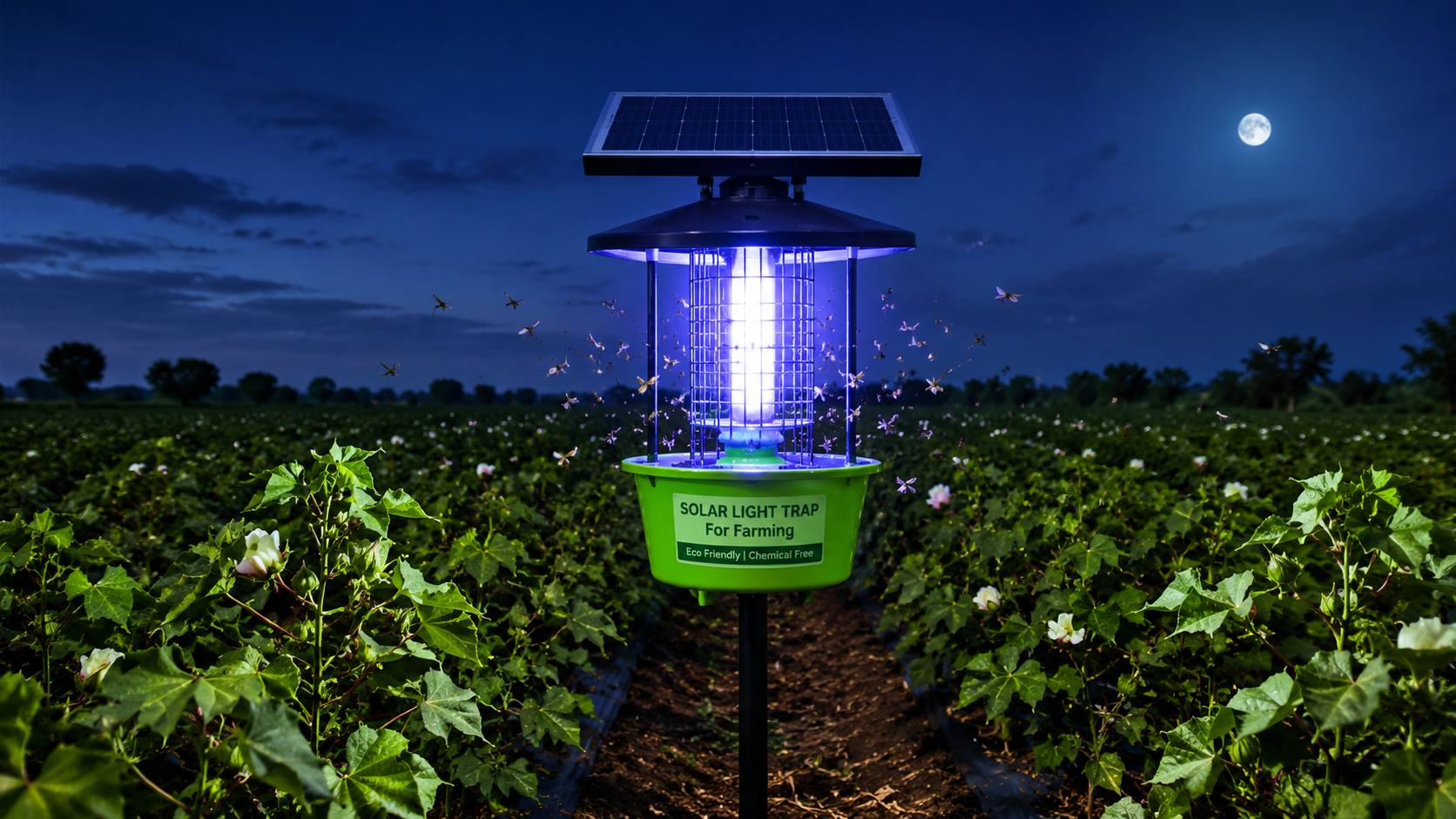
Most crop damage in India does not happen in the middle of the day. It happens after sunset, when farmers are asleep and a wave of moths, borers, and beetles moves through the field unnoticed. By the time the damage shows up on the plant, the pest population has already multiplied. A well-placed solar light trap for farming addresses this problem at precisely the right moment: during the night, at the source, before the damage compounds.
Night-active insects account for a significant share of agricultural crop losses in India. Studies across paddy, cotton, and vegetable-growing belts show that nocturnal pest damage can reduce yield by 15 to 40% in a single season without effective intervention. Yet most conventional pest management tools, from spraying to netting, are designed for daytime use. Solar-powered light traps fill the gap that chemical sprays, manual scouting, and even pheromone traps leave open after dark. This blog breaks down how they work, which pests they target, and why Indian farmers are increasingly adopting them as part of a broader crop protection strategy.
After Dark, In the Field: Understanding the Night Pest Problem in Indian Agriculture
Why Night Is the Most Dangerous Time for Standing Crops
The majority of economically damaging agricultural insects in India are nocturnal. Bollworm moths, stem borers, armyworms, and pod borers all time their peak activity to the hours between dusk and midnight, when temperatures drop slightly, humidity rises, and there is no human presence in the field to disturb them.
A single female bollworm moth can lay 500 to 1,000 eggs in a single night. Stem borer moths, among the most damaging pests in paddy-growing states like Odisha, West Bengal, and Andhra Pradesh, are most active between 8 PM and 11 PM. By morning, the eggs are on the plant, the damage has begun, and the farmer has no visible indication that anything happened until the symptoms appear days later.
The Gap That Conventional Pest Control Cannot Fill
Chemical spraying is typically done in the morning or early evening. By the time residual effects wear off, peak nocturnal pest activity has already occurred. Pheromone traps are species-specific and do not address the broad spectrum of nocturnal insects that visit a field in a single night. Sticky traps are passive and offer monitoring value rather than population control at scale.
This is the gap that an agricultural solar light trap in India is specifically designed to close. Operating continuously through the night on solar-stored power, it attracts and traps the moths, beetles, and winged insects that no other tool reaches during their peak active window.
How a Solar Light Trap Works: From Sunset to Sunrise
The Technology Behind the Trap
The operating principle of a solar light trap for farming is straightforward but precise. During daylight hours, a solar panel charges an integrated battery. After sunset, the UV light activates automatically, emitting a spectrum of light that is highly attractive to nocturnal insects. The light draws moths, beetles, and other flying insects toward the trap, where they fall into a collection chamber and cannot escape.
The UV spectrum used in agricultural light traps is specifically selected for its attractiveness to phototactic insects, which are insects with a biological drive to move toward light sources. Most agricultural pest species fall into this category. The trap does not use any bait, lure, or chemical attractant. The light itself is the mechanism, which means it works across a broad range of species rather than targeting a single pest like pheromone lures do.
Coverage, Placement, and Operational Logistics
A standard farm-grade solar light trap covers approximately 1.5 to 2 acres per unit. For larger holdings, multiple units are deployed at calculated spacing to ensure overlapping coverage with no dark gaps between them. Placement matters significantly: traps work best when positioned at crop canopy height, in the centre of the field, and at least 20 to 30 metres from field boundaries to draw insects away from the edges where they enter.
The trap operates autonomously once installed. There is no electricity connection required, no chemical refilling, and no daily manual intervention. Farmers need to empty the collection chamber every few days, which takes minutes. This ease of operation is one of the most important practical advantages for smallholder farmers who already carry a heavy daily workload.
Battery Life, Cloudy Weather, and Year-Round Reliability
A common practical question from farmers considering solar traps is what happens during overcast or monsoon conditions. Quality farm-grade models are designed with battery reserves that allow 8 to 10 hours of overnight operation even after a day of reduced solar charging. In most parts of India, even cloudy days generate enough diffuse light to partially recharge the battery, maintaining operational continuity across seasons.
The monsoon season is also, in many crops, the period of highest pest pressure. Having a light trap that operates reliably through that period is not a nice-to-have feature; it is a core requirement for effective pest management during the most critical phase of the growing season.
The Organic Farming Connection: Why Chemical-Free Night Pest Control Matters More Than Ever
The Growing Demand for Residue-Free Produce in India
India’s domestic market for organic and low-residue produce is expanding quickly. According to APEDA data, India’s organic food market was valued at over Rs 1,000 crore and growing at more than 20% annually as of recent estimates. Export markets for Indian agricultural produce have also tightened on Maximum Residue Limits (MRLs), with European and Gulf buyers increasingly rejecting consignments that exceed permissible pesticide thresholds.
For farmers who want to tap into these higher-value markets, eliminating or significantly reducing chemical pesticide use is not optional. It is a commercial necessity. Organic insect control farming in India is the framework within which solar light traps play a critical role, providing effective night pest management without contributing any chemical residue to the crop, the soil, or the water table.
Solar Light Traps as a Cornerstone of Organic Pest Management
The principles of organic pest management are built around disruption of pest lifecycles through non-chemical means. Solar light traps contribute to this by removing egg-laying adults from the field before they reproduce. Each moth or beetle caught by the trap represents hundreds of larvae that will not hatch and will not damage the crop. This upstream intervention is significantly more effective, per unit of effort, than trying to manage larvae after they have already infested a plant.
Within the framework of organic farming solutions in India, solar light traps integrate naturally alongside other non-chemical tools including pheromone traps, bio-pesticides, beneficial insect habitat creation, and crop rotation. Together, these approaches create an integrated pest management system that reduces chemical dependency progressively season by season.
What Documented Field Results Tell Us About Effectiveness
The Indian Council of Agricultural Research (ICAR) and various state agricultural universities have published field data on light trap-based pest management across multiple crop systems. In paddy, trials in Chhattisgarh and Tamil Nadu recorded significant reductions in stem borer infestation in plots using light traps compared to untreated controls, without any chemical application.
In cotton-growing regions of Vidarbha, farmers using integrated approaches that include solar light traps reported bollworm damage rates 30 to 45% lower than in neighbouring plots relying solely on chemical spraying. In vegetable clusters around Nashik and Pune, consistent light trap use correlated with reduced fruit borer incidence and improved produce quality scores at market.
Choosing and Using Solar Light Traps Effectively on Indian Farms
Matching the Right Trap to the Right Farm Context
The variety of solar light trap products available in India spans a wide range of form factors and coverage capacities. Mini traps priced around Rs 870 are appropriate for kitchen gardens, nurseries, or very small plots where pest monitoring is the primary goal. Farm-grade models covering 1.5 to 2 acres, priced between Rs 2,400 and Rs 3,000, are the workhorse product for most smallholder and mid-size farm operations. For large commercial fields or grain storage facilities, higher-capacity options are available, including specialised UV light traps for godowns that target stored grain moths and beetles.
Crop type also influences selection. Tall crop canopies like sugarcane or maize require traps positioned differently than low-growing crops like pulses or vegetables. Knowing your primary pest and its peak flight height helps determine optimal trap placement and the right UV spectrum for the model you choose.
Conclusion
Night pests are a significant and underappreciated driver of crop loss in Indian agriculture. The window between sunset and sunrise is when the most damaging insects lay eggs, feed, and reproduce, largely without interference from conventional pest management methods. A well-deployed solar light trap for farming closes that window reliably, cost-effectively, and without chemicals, making it one of the most practical investments a farmer can make in long-term crop protection.
For farmers ready to shift from reactive chemical spraying to proactive, science-backed pest management, Sonoris Farms Agrotech offers a tested range of solar light traps, pheromone systems, and integrated pest management tools designed specifically for Indian crop conditions. Explore the full range at Sonori. in and find the right solution for your crop and your farm.
Frequently Asked Questions (FAQs)
- How many solar light traps are needed for a 5-acre farm?
A standard solar light trap usually covers around 1.5 to 2 acres. For a 5-acre farm, approximately 3 traps are recommended for effective pest control coverage. - Do agricultural solar light traps work during the monsoon season?
Yes, high-quality solar light traps come with battery backup systems that allow them to operate efficiently even during cloudy or rainy conditions. - What is the difference between a solar light trap and a pheromone trap?
Solar light traps attract a wide range of insects using UV light, while pheromone traps target specific pests using chemical attractants. Both are commonly used together in integrated pest management. - How does organic insect control reduce chemical residue in crops?
Organic pest control methods reduce the use of chemical pesticides, helping lower chemical residue levels and improving crop safety and quality. - Are organic farming solutions economically beneficial for small farmers?
Yes, organic farming tools like solar light traps and pheromone traps are cost-effective and often provide returns within one crop season through reduced pesticide expenses and healthier yields.
