

- Your cart is empty
- Continue shopping
-
sonoriagr
- Posted on
- Categories:Eco Technology
- 0 comments
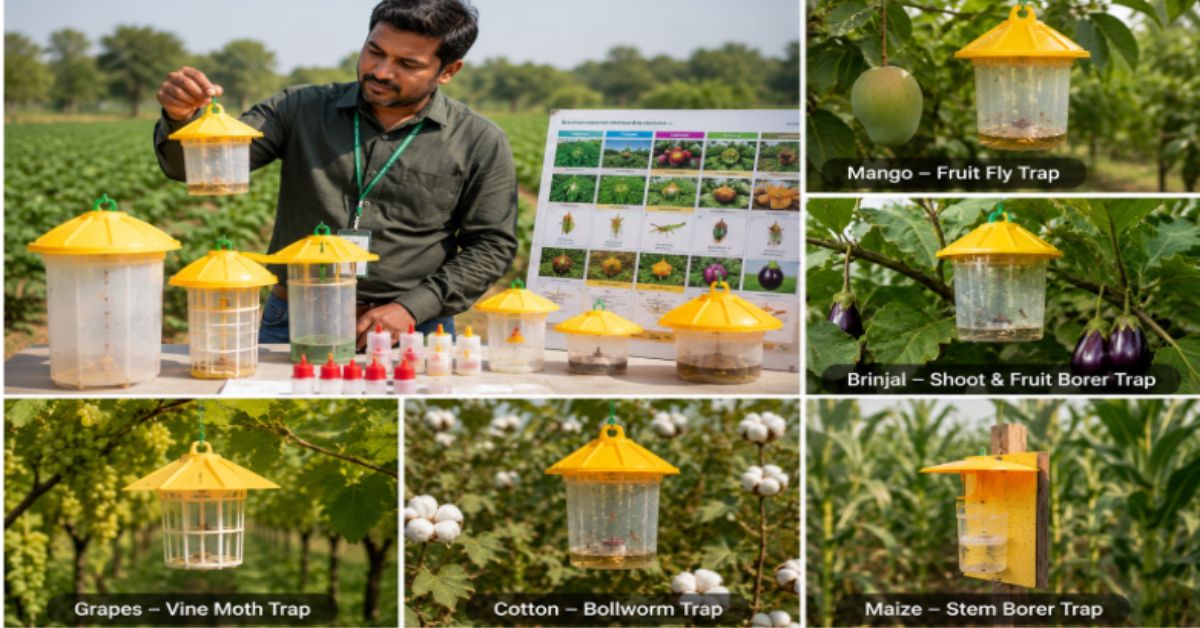
Every season, Indian farmers lose between 15% and 25% of their total crop yield to pest damage. Using a pheromone trap in India is one of the most direct ways to reduce that loss without adding more chemicals to the field. These traps work by mimicking natural insect signals to attract and capture specific pest species before they can reproduce, feed, or spread across the crop. They are low-cost, easy to set up, and proven across dozens of crops and pest categories throughout the country.
Yet many farmers still do not get full value from them, either because the trap is placed at the wrong height, the lure is left in too long, or the density of traps per acre is too low. This guide walks through every step of proper pheromone trap deployment so you can achieve maximum pest control results on your farm.
Why a Pheromone Trap Supplier in India Is Key to Getting Started Right
Understanding the Role of a Pheromone Trap Supplier in India for Quality Input
The effectiveness of any pheromone-based pest control system starts well before the trap reaches the field. It starts with the quality of the lure inside the trap. A synthetic pheromone lure works by releasing specific chemical compounds that mimic the sex signals of female pest insects, drawing male moths or flies into the trap before they can mate. If the chemical loading in the lure is insufficient, or if the compound is not correctly formulated for the target species, the trap will not attract the pest you are trying to control.
This is why sourcing from a reliable pheromone trap supplier in India matters so much. Domestic suppliers who test their products before dispatch and clearly label each lure with the target species, active ingredient, and shelf life give farmers the assurance that what they deploy in the field will actually work. Farms in Maharashtra, Karnataka, and Odisha that have switched to verified domestic supplier networks consistently report better trap catch rates compared to farms using unlabelled or low-cost lures from unknown channels.
When choosing a supplier, look for combo packs that include both the lure and the trap together. This removes the risk of buying incompatible components and ensures that the lure dispenser rate is matched to the trap design for maximum field performance. A good pheromone trap supplier in India will also offer lures for multiple crops and pest species so you can cover your full pest management needs from a single source.
Intelligent Farming Solutions: Choosing the Right Trap Type for Your Crop
Matching Trap Design to Pest Species and Field Conditions as Part of Intelligent Farming Solutions
Not every trap design works for every pest. Choosing the right physical trap for your target species is a core part of applying intelligent farming solutions on your land. The three most widely used designs in Indian field conditions are funnel traps, delta traps, and water pan traps.
Funnel traps are the most durable and weather-resistant option. The insect enters through a wide funnel at the top, falls into a sealed collection chamber, and cannot climb back out. Funnel traps perform well through monsoon rains and strong winds and are the preferred choice for mass trapping applications on cotton, paddy, and maize.
Delta traps use a triangular cardboard frame with a sticky insert. The insect lands on the sticky surface after entering and is captured there. Delta traps are easier to inspect and count, making them the better choice for monitoring applications where you want a daily headcount of pest flight intensity rather than simple suppression.
Water pan traps are the simplest design, using a bright yellow or blue pan filled with water and a small amount of soap solution. They work best for flying insects such as whitefly and aphids on vegetable crops and are used more for early detection than mass trapping.
Applying intelligent farming solutions means matching your trap choice to the specific pest behavior. Night-flying moths such as bollworms, stem borers, and armyworms are best captured in funnel or delta traps baited with pheromone lures. Day-active insects are better handled with sticky or pan traps. Using the right tool for the specific pest is what separates effective deployment from wasted investment.
How to Use a Pest Monitoring Trap for Early Warning and Threshold-Based Action
Setting Up a Pest Monitoring Trap Network Across Your Field for Maximum Coverage
A pest monitoring trap is one of the most practical and affordable early warning systems available to Indian farmers. When deployed correctly at the start of the growing season, it gives you a daily live reading of pest flight activity in your specific field so you can time your interventions accurately rather than following a fixed calendar spray program.
To set up a proper monitoring network, place 2 to 3 traps per hectare distributed evenly across the field. Do not cluster all traps at the field edges. Edge traps monitor immigration from outside the field, not the actual internal pest population. Distribute traps at regular intervals across the full planting area to get a representative picture of what is happening across the crop.
Check trap catches every morning at the same time. Record the count in a simple field log that tracks date, trap location, catch number, and lure replacement date. Over the first 2 weeks of deployment, you will build a baseline picture of normal flight activity for your field. Any spike in catches above that baseline is your early warning signal that pest populations are building.
Most crop protection extension guidelines set economic threshold levels for specific pest species. For yellow stem borers in paddies, a catch of 5 or more moths per pest monitoring trap per night indicates that targeted intervention is justified. For American bollworm on cotton, catches of 8 or more moths per trap per night serve as the threshold. Acting at the threshold rather than waiting for visible plant damage routinely reduces the number of spray applications farmers need per season by 30 to 50%.
Replacing Lures on Schedule to Maintain Monitoring Accuracy Throughout the Season
The most common mistake farmers make with pheromone traps is leaving the lure in place too long. Most standard pheromone lures have an effective field life of 4 to 6 weeks. After this period, the chemical dispersion rate drops below the threshold needed to reliably attract the target pest at the distances required for field-scale coverage.
The problem is that a depleted lure looks exactly the same as an active one from the outside. A farmer who sees low trap catches in week 8 cannot tell whether catches are low because pest pressure is genuinely low or because the lure has stopped working. This is why scheduled replacement matters. Replace lures every 4 weeks regardless of what the catch log shows. When you replace a lure, record the date on the trap. This keeps your monitoring data reliable throughout the season.
Scaling Up: Using Lure and Trap Systems for Farming to Achieve Mass Pest Suppression
Increasing Trap Density with Lure and Trap Systems for Farming to Shift From Monitoring to Control
When the goal shifts from monitoring pest populations to actively suppressing them, the approach changes significantly. Lure and trap systems for farming at mass trapping density are designed to capture a meaningful proportion of the adult male pest population before mating occurs, which directly reduces the number of eggs laid and the size of the next larval generation.
For mass trapping on cotton, the recommended deployment is 5 to 8 funnel traps per acre placed from the first week of crop emergence. At this density, trap networks covering a 10-acre block can intercept enough adult males to produce a measurable reduction in larval populations in the following generation. ICAR field trials in Maharashtra have shown that correctly deployed mass trapping networks reduce bollworm larval counts by 40 to 60% compared to unprotected control plots.
On paddy, fall armyworm lure systems deployed at 10 to 12 traps per hectare from the early vegetative stage capture peak adult flight before egg-laying peaks. On vegetable crops where export residue requirements make chemical spraying risky, lure and trap systems for farming combined with bio-pesticide spot applications at threshold levels create a chemical-free crop protection program that satisfies even the strictest overseas buyer residue standards.
Adjusting Trap Height and Placement as the Crop Grows for Consistent Catch Rates
Trap height relative to the crop canopy directly affects catch rates. Pheromone plumes disperse most effectively at or just above the crop canopy, where adult moths fly actively between plants. A trap that was correctly positioned at crop canopy height in week 2 may end up buried inside a dense canopy by week 6 as the crop grows, dramatically reducing its attraction radius and catch rate.
Adjust trap height every 2 to 3 weeks through the season to keep the trap opening at or just above the top of the crop. On tall crops like cotton and maize, this may mean adding extension poles or repositioning trap stakes as the season progresses. The few minutes spent adjusting trap height on each inspection visit are directly reflected in the reliability of your catch data and the effectiveness of your suppression program.
Conclusion
Using a pheromone trap in India the right way comes down to four things: the right lure for the target pest, the right trap design for the field conditions, the right density for the objective, and consistent maintenance through the season. When these four elements align, pheromone traps deliver pest population data that no other tool can match at comparable cost, and when deployed for mass trapping, they directly reduce the next generation of damaging larvae before they reach the crop.
For farmers looking to build a smarter, more sustainable approach to crop protection, Sonoris Farms Agrotech offers a tested range of pheromone lure and funnel trap combo packs designed specifically for Indian crop conditions. Whether you grow cotton in Vidarbha, paddy in Odisha, or vegetables for export markets, the right pheromone trap system is available at Sonoris Farms Agrotech.
Frequently Asked Questions (FAQs)
Q1. What makes a pheromone trap in India different from a regular insect trap?
A pheromone trap in India uses a synthetic chemical lure that mimics insect sex signals to target a specific pest species, while regular insect traps rely on light or broad attractants that capture a wide range of non-target insects without addressing the reproductive cycle of the pest.
Q2. How do I know which pheromone lure to buy for my crop?
Each pheromone lure is species-specific, so identify the primary pest historically causing the most damage to your crop and then source a lure specifically labeled for that species from a verified pheromone trap supplier in India to ensure correct chemistry and sufficient active compound loading.
Q3. Can pheromone traps completely replace chemical pesticide sprays?
Pheromone traps work best as one layer within a broader integrated pest management program that includes biopesticides and threshold-based spraying, and while they significantly reduce the number of chemical applications needed per season, they are most effective when combined with other intelligent farming solutions rather than used as a standalone replacement.
Q4. How often should I check and maintain my pest monitoring trap?
Check your pest monitoring trap every morning at the same time, record catch counts in a field log, replace lures every 4 weeks on schedule, and adjust trap height every 2 to 3 weeks to keep it at or just above the crop canopy as the season progresses.
Q5. How many traps per acre do I need for mass pest suppression using lure and trap systems for farming?
For mass pest suppression, lure and trap systems for farming require 5 to 8 funnel traps per acre on cotton and 10 to 12 traps per hectare on paddy and vegetable crops, distributed evenly across the full field area rather than concentrated at the edges.
