

- Your cart is empty
- Continue shopping
-
sonoriagr
- Posted on
- Categories:Eco Technology
- 0 comments
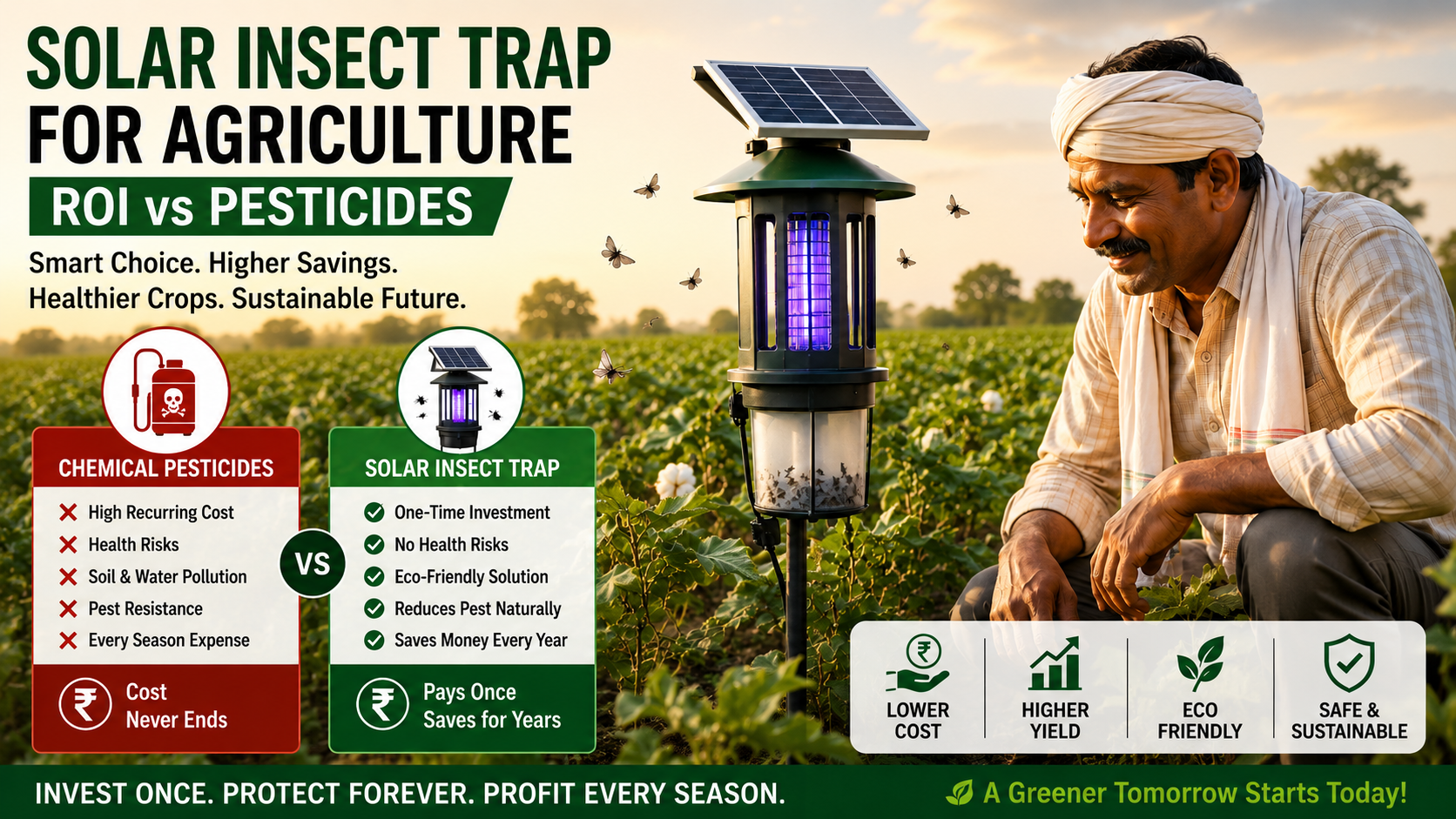
Introduction
As each farming season starts on an optimistic note, it frequently comes to a conclusion with increased expenditure on farm inputs. Pesticides are considered as the major repetitive expense incurred by Indian farmers. Repeated usage of pesticides, cost of application services, fuel, and increasing pesticide resistance has resulted in reduced total farm earnings. After various applications, farmers still suffer from frequent crop infestations that cause losses in yields.
In such a scenario, innovative farming strategies, including solar insect traps for agriculture, gain prominence among farmers. These insect traps use light systems powered by solar energy to attract and eliminate pests without the need to spend money repetitively on chemical pesticides. Although the initial expense of installing a solar insect trap seems relatively higher than the cost of purchasing pesticides for a season, the former proves more economical in the long run.
The True Cost of Chemical Pesticides That Most Farmers Never Add Up
Breaking Down What One Season of Spraying Actually Costs
Most farmers think of pesticide costs as a single purchase at the local agri-input store. But the real number includes much more. For a mid-size farm growing cotton, paddy, or vegetables in India, a full season of chemical pesticide cost reduction in India has not happened yet because the true cost is rarely tracked in one place.
Here is what a realistic seasonal pesticide cost looks like for a 2-acre plot:
- Pesticide products: Rs 4,000 to Rs 8,000 per season depending on crop and pest pressure
- Spraying labour: Rs 1,500 to Rs 3,000 for hired help or time diverted from other farm work
- Protective equipment (masks, gloves): Rs 500 to Rs 1,000 if used consistently
- Repeat applications: 3 to 6 rounds per season, each adding to the cumulative cost
- Residue management and washout water: often ignored but a real operational cost
Total seasonal expenditure per 2 acres frequently ranges between Rs 10,000 and Rs 20,000. Multiplied across 5 years, that is Rs 50,000 to Rs 1,00,000 spent on inputs that offer no cumulative value, require repeat purchasing, and carry ongoing health and soil risks.
The Hidden Costs That Never Show Up in the Bill
Beyond the purchase price, chemical pesticides carry costs that rarely appear on any invoice. Soil health degradation from repeated chemical applications reduces long-term yield potential, sometimes by 10 to 20% over a decade. Farmer health risks from pesticide exposure in India are well-documented, with the National Institute of Occupational Health linking chronic pesticide use to neurological, reproductive, and respiratory issues.
The rejection by buyers demanding lower residue levels is a growing problem for export-oriented farmers. And increasingly, consumer demand is shifting toward residue-free produce, meaning chemically farmed produce is beginning to carry a pricing premium over cleaner alternatives.
Why the Calculation Never Ends With Chemical Pest Control
One of the most important economic differences between chemicals and solar alternatives is that pesticide spending never stops. Every new season, the cost resets and begins again. There is no point at which the chemical investment pays for itself. It is a permanent and recurring expense with no capital value. This is the foundational problem that agricultural technology in India is beginning to address by offering tools that have a one-time cost and multi-year utility.
How a Solar Insect Trap Works and Why the Economics Are Fundamentally Different
The Mechanism: Light, Power, and Precision
A solar insect trap for agriculture operates on a straightforward principle. A solar panel charges a battery through the day. After dark, a UV light activates and attracts nocturnal insects, which are then trapped in a collection chamber. No electricity connection is needed. No chemicals are used. No labour is required for the trap to do its job each night.
This simple mechanism covers the pest management need for anywhere between 1.5 to 2 acres per unit, depending on the model and terrain. Field insects including moths, beetles, and various crop-damaging nocturnal species are drawn to UV light at night and eliminated before they can damage the crop or reproduce. The result is measurable pest pressure reduction that becomes visible within the first few weeks of deployment.
One-Time Cost, Multi-Year Value: Where the ROI Story Begins
Entry-level solar powered pest killer in India are now available at price points ranging from Rs 870 for small garden or plot deployments up to Rs 2,400 to Rs 3,000 for 1.5 to 2-acre farm-grade units. These are one-time purchases. The solar panel and battery are designed for multi-year use. The only recurring cost, if any, is periodic cleaning of the collection chamber, which takes minutes.
Set against a seasonal pesticide spend of Rs 10,000 to Rs 20,000 per 2 acres, a Rs 2,400 to Rs 3,000 trap pays for itself well within a single growing season. Every season after that is savings, not spending.
The ROI Comparison in Numbers
The table below directly compares the cost of chemical pesticides against a solar trap over 5 years for a standard 2-acre farm:
| Cost Factor | Chemical Pesticides (per acre/year) | Solar Insect Trap (5-year avg) |
| Purchase / Input Cost | Rs 4,000 to Rs 8,000+ | Rs 600 to Rs 800 (amortised) |
| Labour (spraying) | Rs 1,500 to Rs 3,000 | Negligible (self-operating) |
| Health & Safety Risk | High (toxic exposure) | None |
| Soil / Residue Impact | Long-term degradation | Zero chemical residue |
| Recurring Cost (annual) | Full cost every season | Near zero (solar powered) |
| Break-even Point | Never (permanent expense) | Season 1 to 2 |
Over 5 years, a farmer who switches from chemical pesticides to solar traps on a 2-acre plot stands to reduce pest-related input costs by Rs 40,000 to Rs 80,000 or more, while also improving soil quality and reducing health risk.
What Indian Farmers Are Actually Experiencing on the Ground
Real Outcomes From Fields Across India
Adoption of agricultural technology in India is accelerating among both smallholders and progressive commercial farmers. In Vidarbha, cotton farmers trialling solar light traps reported a reduction in bollworm damage of 30 to 45% within a single season. In Odisha, paddy farmers using combination approaches with solar traps and pheromone traps saw significant reductions in stem borer incidence without any additional chemical application.
These are not isolated outcomes. The Indian Council of Agricultural Research (ICAR) has documented the effectiveness of solar light traps across multiple crop types including rice, cotton, maize, and vegetable crops. Pest catch rates per night per trap range from dozens to several hundred insects depending on the season and pest pressure, each one removed from the reproductive cycle before it can cause crop damage.
Why the Adoption Curve Is Steepening in 2025 and 2026
Several factors are converging to push adoption of solar-powered pest killer in India solutions higher than in any previous period. Product prices have come down significantly as manufacturing scale increases. Government subsidy schemes for solar agricultural equipment have made the tools more accessible. And the growing market for residue-free produce, particularly in vegetable and fruit export crops, is creating a direct income incentive for farmers to reduce chemical dependence.
Digital agri-commerce platforms have also made purchasing easier. Farmers in Amravati, Nashik, or Guntur can now order a trap for their specific acreage and receive it within days, which was not the case even three years ago.
Combining Solar Traps With Other Eco-Friendly Solutions for Maximum Effect
Solar insect traps work best as part of an integrated pest management strategy rather than as a standalone tool. When combined with pheromone traps, which target specific species using chemical lures, and sticky traps for monitoring pest populations, the coverage and effectiveness multiplies significantly. This layered approach allows farmers to virtually eliminate the need for broad-spectrum chemical spraying while maintaining or improving crop protection outcomes.
Brands like Sonoris Farms have built their product range specifically around this kind of integrated approach, offering solar traps, pheromone systems, and sticky traps as a coordinated pest management toolkit rather than standalone items.
Choosing the Right Solar Trap for Your Farm: Practical Buyer Guidance
Matching the Trap to the Acreage
Not every trap is designed for every farm size. A mini solar trap priced around Rs 870 is appropriate for home gardens, small plots, or nurseries. For working agricultural fields, a 1.5-acre or 2-acre grade trap in the Rs 2,400 to Rs 3,000 range is the standard starting point. Large-format options like the Farrow Light Trap are designed for much larger operations and offer broader-spectrum coverage.
Farmers managing grain storage should also consider a UV light trap specifically designed for godowns, which targets the insect species most commonly associated with stored grain spoilage and is a very different use case from field pest management.
Key Specifications to Evaluate Before Buying
When comparing solar insect trap models, look closely at these factors:
- Battery capacity and backup: the trap should operate for at least 8 to 10 hours on a full charge to cover a full night
- UV light spectrum: different spectra attract different insect families; check that the trap is appropriate for your primary pest pressure
- Build quality and weather resistance: traps in the field face rain, wind, and temperature extremes across seasons
- Ease of cleaning: collection chambers that are difficult to access or clean tend to be used less diligently
- Coverage area rating: do not underestimate the number of traps needed for large or irregular-shaped fields
Where to Source Reliable Products in India
Buying from a trusted domestic agritech supplier is important both for quality assurance and for after-sale support. Sonoris Farms Agrotech, based in Amravati, supplies a tested range of solar insect traps with farmer-focused product specifications, shipping across India, and direct customer support on product selection and usage. Their product range spans everything from mini traps for small plots to large-format solutions for commercial operations.
Conclusion
The economics of pest management in Indian agriculture are shifting. Chemical pesticides have been the default for decades, but that default is built on habit rather than ROI. When you put the actual numbers on paper, a solar insect trap for agriculture does not just offer a greener alternative. It offers a cheaper one, and one that gets more cost-effective with every passing season while the pesticide bill stays the same or rises.
For Indian farmers looking to reduce input costs without compromising on crop protection, the calculation points clearly in one direction. Explore the full range of solar insect traps and integrated pest management solutions from Sonoris Farms Agrotech at sonori.in and find the right solution for your crop, your field, and your budget.
Frequently Asked Questions (FAQs)
- How quickly does a solar insect trap for agriculture pay for itself?
Most solar insect traps recover their cost within one growing season by reducing pesticide expenses. - Can a solar powered pest killer in India work effectively during cloudy seasons?
Yes, quality solar traps can run overnight using battery backup even during cloudy weather. - What crops benefit most from solar insect traps in India?
Cotton, paddy, maize, vegetables, and pulses benefit the most from solar insect traps. - Is pesticide cost reduction in India achievable with solar traps alone?
Solar traps work best with pheromone and sticky traps as part of integrated pest management. - What role does agricultural technology in India play in making farming more profitable?
Agritech tools like solar traps reduce farming costs and improve crop quality and profitability.
