

- Your cart is empty
- Continue shopping
-
sonoriagr
- Posted on
- Categories:Eco Technology
- 0 comments
Indian farmers lose close to Rs 90,000 crore every single year to pest damage. That number alone should make every grower pause. But what makes it worse is how much of that loss happens because of over-reliance on chemical pesticides that cost money, harm soil health, and leave residues on crops that buyers no longer want. The good news? There is a better path. Eco-friendly pest control solutions in India are no longer a niche concept practiced by a handful of progressive farmers. They are becoming the standard for anyone who wants to protect yield, reduce costs, and meet the growing demand for clean, residue-free produce.
Whether you manage 2 acres of vegetables or 200 acres of cotton, the core challenge stays the same. Pests arrive, and you need a way to manage them that does not drain your wallet or degrade your farm over time. This guide covers the 5 most effective and field-proven eco-friendly pest control solutions in India that are working right now, across crop types, farm sizes, and growing regions.
1. Natural Pest Control for Crops Using Pheromone Traps
How Pheromone Chemistry Works to Suppress Pest Populations at the Source
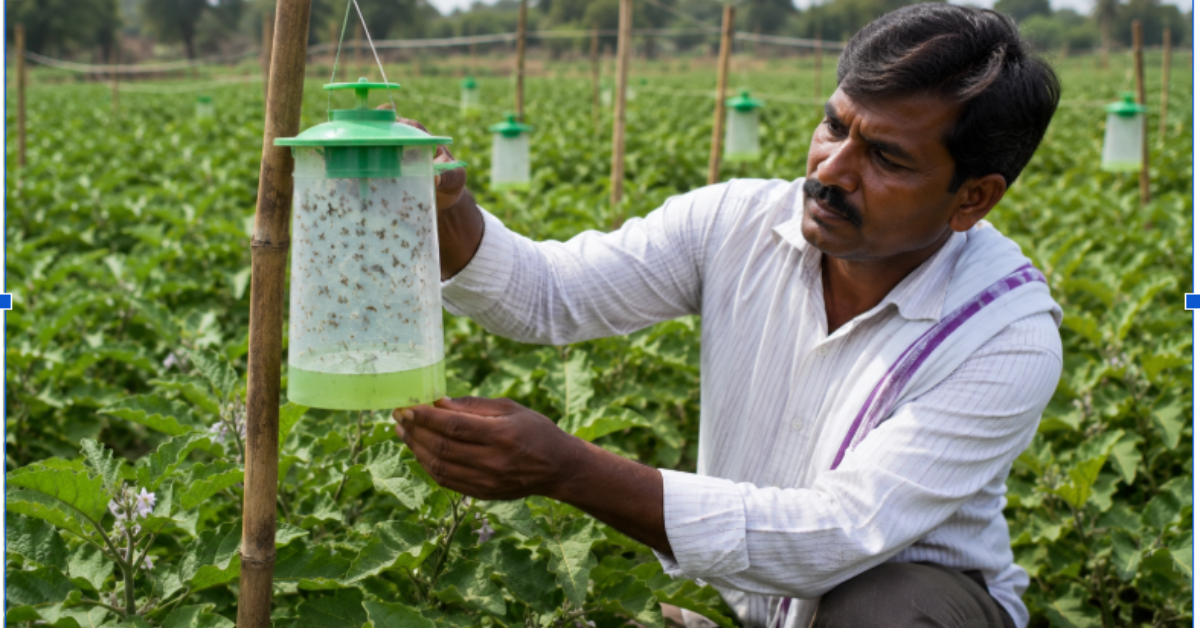
Pheromones are chemical signals insects produce to communicate with each other. Female moths of most agricultural pest species release sex pheromones to attract males for mating. Scientists have isolated and synthesised these compounds for dozens of economically important pest species. When a synthetic pheromone lure is placed inside a funnel trap and hung in the field, it creates an irresistible chemical signal that pulls male insects from distances of up to 100 meters.
The male that enters the trap does not return. More importantly, it is a male that will not fertilize dozens of females. Each unmated female will not lay hundreds of eggs that would have become larvae tunnelling into cotton bolls, tomato fruit, or paddy stems. The intervention happens at the reproductive stage, which is where small numbers of trapped insects translate into large, measurable reductions in crop damage. This is one of the most powerful forms of natural pest control for crops available to Indian farmers today.
Which Crops and Pests Are Best Managed Through Pheromone Trapping in India
Pheromone trap coverage across Indian agriculture now includes pink bollworm and American bollworm on cotton, yellow stem borer on paddy, fall armyworm on maize, tobacco caterpillar on vegetables, and fruit fly on mango and guava. Each lure is species-specific. A bollworm lure will not attract a stem borer.
Field trials by ICAR and multiple state agricultural universities have shown that deploying pheromone traps at 5 to 8 traps per acre for mass trapping can reduce bollworm populations by 40 to 60 percent compared to untreated plots. For cotton farmers in Maharashtra and Telangana who are spending Rs 8,000 to Rs 12,000 per acre on chemical sprays each season, even a 2-round reduction in spray applications directly adds to net profit.
2. Integrated Pest Management in India Using Solar Insect Traps
Why Solar Light Traps Are an Essential Component of Integrated Pest Management in India
Most crop damage in India does not happen during the day. It happens after sunset, when nocturnal pest species are most active. Moths lay eggs, caterpillars feed, and populations build up in the dark, often going undetected until the crop shows visible damage. Solar insect traps address this gap directly. They charge during the day and automatically switch on at dusk, drawing in night-flying insects from the surrounding area using ultraviolet light and a fan or water trap that prevents escape.
Unlike chemical sprays that must be timed to a specific pest population stage, solar light traps work every night, across the entire growing season, with zero recurring cost beyond occasional cleaning. For farmers practicing integrated pest management in India, solar traps function as the broad-spectrum baseline layer of a multi-tool system. They remove a wide range of nocturnal pests from the field continuously while pheromone traps handle species-specific monitoring and suppression.
Solar Insect Traps Across Farm Scales: From One-Acre Vegetable Plots to Large Cotton Fields
For small-scale farmers managing 1 to 5 acres, a single solar insect trap placed at the center of the field can protect the entire plot. For larger operations of 20 acres or more, a grid of traps spaced 30 to 40 meters apart provides effective coverage across the full cropped area. The absence of electricity dependency is critical here. Farmers in areas with unreliable power supply or no grid connection at all can still deploy solar traps without modification.
One Maharashtra soybean farmer reduced his night-spray applications from 4 per season to 1 after deploying solar insect traps combined with regular monitoring. His input cost dropped by approximately Rs 3,200 per acre, and his residue test results improved enough to qualify for a premium buyer contract the following season.
3. Organic Insect Control Farming in India Through Sticky Traps
How Sticky Traps Support Organic Insect Control Farming in India for Early Pest Detection
Sticky traps are one of the most cost-effective tools in organic insect control farming in India. Yellow sticky traps attract whiteflies, aphids, leaf miners, and thrips, which are some of the most destructive sucking pests on vegetables, cotton, and pulses. Blue sticky traps target thrips specifically. These traps do not use any chemicals, pheromones, or power. They are passive monitoring devices that catch flying pests on a coated adhesive surface.
The key benefit is early detection. A farmer who places sticky traps at the start of the season and checks them every 2 to 3 days knows exactly when pest populations begin building up. That window, usually 7 to 10 days before visible plant damage appears, is when targeted intervention is most effective and least expensive. Acting on sticky trap data rather than on visible crop symptoms consistently reduces the number of spray applications needed per season.
Sticky Trap Deployment Recommendations for Small and Large Scale Indian Farms
For vegetable crops on small farms, 8 to 10 sticky traps per acre placed at crop canopy height is the standard recommendation. For large-scale operations managing pulse or cotton crops, a lighter monitoring density of 4 to 6 traps per acre is sufficient to detect threshold-level infestations early. Traps should be replaced every 3 to 4 weeks or sooner when the surface is more than 70 percent covered.
Organic and export-oriented vegetable clusters in Karnataka, Maharashtra, and Tamil Nadu have incorporated sticky traps as a mandatory baseline monitoring tool. Buyers sourcing certified organic produce increasingly require documented trap monitoring records as part of the farm audit process.

4. Natural Pest Control for Crops Using Neem-Based Botanical Treatments
Understanding How Neem Functions as a Contact and Systemic Natural Pest Control for Crops
Neem has been used in Indian agriculture for centuries, but modern formulations have made it significantly more effective than the crude oil sprays of the past. The active compound in neem, azadirachtin, works as an insect growth regulator. It does not kill insects instantly. Instead, it disrupts the molting process, prevents larvae from progressing through their growth stages, and reduces adult feeding activity.
Neem-based neem oil at 3 to 5 ml per liter of water, applied in the early morning or late evening to avoid degradation by direct sunlight, provides effective control of aphids, mites, whiteflies, and early-stage caterpillars on vegetables, pulses, and fruit crops. Neem has a short residue half-life of 5 to 7 days, which means produce can be harvested within a week of application without residue concerns in most markets.
Neem Combined With IPM for a Cost-Effective and Residue-Free Crop Protection System
Neem works best as part of a layered pest management system. It is not a standalone replacement for population-level pest suppression tools like pheromone traps or solar light traps. But as a targeted contact treatment when monitoring traps indicates that population thresholds have been crossed, neem provides a chemical-free spray option that is safe for beneficial insects, pollinators, and natural enemies of pest species.
Small-scale vegetable farmers in Kerala and Tamil Nadu using neem spray combined with yellow sticky trap monitoring have reported a reduction of 60 to 70 percent in synthetic insecticide use per season. The combination also improves the likelihood of passing residue tests for domestic supermarket supply chains that require below-MRL produce.
5. Integrated Pest Management in India Through Biofertilizer and Microorganism Solutions
How Biofertilizers and Soil Microorganisms Support Integrated Pest Management in India by Strengthening Crop Immunity
Pest pressure on a crop is rarely just about the pest. It is also about the crop itself. Plants growing in soil with poor microbial diversity and unbalanced nutrition are more susceptible to pest attack and less able to recover when damage occurs. Biofertilizers address this at the root level. Beneficial microorganisms such as Trichoderma, Pseudomonas fluorescens, and Bacillus subtilis actively suppress soil-borne pathogens and stimulate the crop’s natural defense mechanisms.
Trichoderma, for example, colonizes the root zone and competes with and suppresses fungal pathogens including Fusarium, Pythium, and Rhizoctonia that cause damping-off and root rot in paddy, vegetables, and pulses. Pseudomonas fluorescens produces antibiotics that suppress bacterial diseases and also acts as a biocontrol agent against certain pest species when applied as a foliar spray. These are not slow, marginal benefits. Trials across paddy and vegetable crops in India have shown plant stand improvements of 15 to 25 percent in Trichoderma-treated plots compared to untreated controls.
Combining Microorganism Solutions With Physical Traps for a Complete Organic Pest Management System
The most effective eco-friendly farm systems in India today combine multiple tools across two layers. The first layer is active pest removal using pheromone traps, solar insect traps, and sticky traps. The second layer is biological strengthening of the crop through biofertilizers and microorganism soil treatments that make the crop less vulnerable to attack in the first place.
A cotton farmer in Vidarbha using this combined approach across 15 acres reported that his bollworm trap catches remained below the economic threshold for 11 out of 14 weeks in the season, meaning he required only 1 targeted spray application compared to the 4 to 5 he had applied in previous seasons. His biofertilizer application cost him Rs 800 per acre but saved an estimated Rs 4,500 per acre in pesticide and labor costs.
Conclusion
The shift toward eco-friendly farming is not a trend driven by urban buyers alone. It is a financially rational decision for farmers at every scale. Chemical input costs in India have risen by 30 to 40 percent over the past 5 years, while produce prices have remained volatile. Every rupee saved on unnecessary sprays is a rupee that stays in the farmer’s pocket. Every clean batch of produce without chemical residue opens a door to a better market and a better price. Eco-friendly pest control solutions in India offer all of this, along with healthier soil, protected natural enemies, and a farming system that sustains itself year after year.
For farmers who are ready to make that shift, Sonoris Farms Agrotech provides a tested and field-ready range of pheromone lure and trap combo packs, solar insect traps, sticky traps, microorganism solutions, and integrated pest management tools designed specifically for Indian crop conditions.
Frequently Asked Questions (FAQs)
1.Are eco-friendly pest control solutions in India as effective as chemical pesticides?
Yes. When deployed correctly, tools like pheromone traps, solar insect traps, and neem-based treatments provide effective pest suppression at comparable or lower cost, with the added benefit of no chemical residue on the crop.
2.What is the best natural pest control for crops affected by bollworm in India?
Pheromone lure traps deployed at 5 to 8 traps per acre for mass trapping are the most targeted and cost-effective natural pest control for crops affected by bollworm species on cotton, tomato, and chickpea.
3.How does integrated pest management in India differ from conventional spraying?
Integrated pest management in India combines monitoring tools like pheromone traps and sticky traps with threshold-based intervention, meaning farmers only spray when pest populations exceed the economic injury level rather than on a fixed calendar schedule.
4.Is organic insect control farming in India suitable for large-scale farmers with 50 acres or more?
Organic insect control farming in India scales effectively to large farms. Solar insect traps, pheromone trap grids, and biofertiliser soil treatments are all scalable tools that reduce per-acre input costs even at high acreage.
5.How quickly can a farmer see results after switching to eco-friendly pest management?
Most farmers report measurable reduction in pest trap catch within the first 2 to 3 weeks of deployment and a reduction in spray applications by the second month of the season.
