

- Your cart is empty
- Continue shopping
-
sonoriagr
- Posted on
- Categories:Eco Technology
- 0 comments
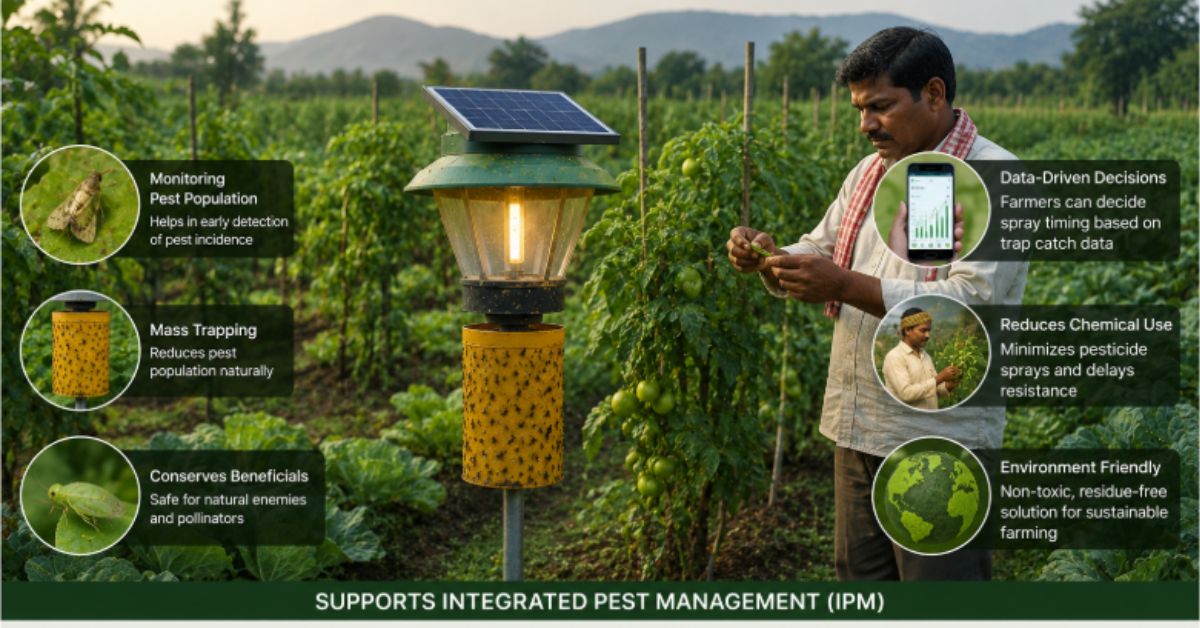
If you are a farmer who has watched pests silently destroy a field you spent months cultivating, you are not alone. Millions of farmers across India face the same problem every single season. The solar insect trap in India has emerged as one of the most reliable answers to this challenge, offering farmers a practical, field-tested, and completely chemical-free way to protect standing crops. It does not require electricity from the grid, does not need daily chemical refills, and works through the night when pest activity peaks. This guide breaks down exactly what a solar insect trap in India is, how it operates, which crops and pests it addresses, and why farmers across the country are increasingly choosing it over conventional pest control methods.
What Is a Solar Light Trap for Agriculture and Why Is It Different?
Defining the Device: A Simple Tool with Serious Impact
A solar light trap for agriculture is a standalone pest management device that uses solar energy to power an ultraviolet (UV) light through the night. The UV light attracts phototactic insects, which are insects that are biologically drawn toward light sources, and draws them into a collection chamber from which they cannot escape. There are no toxic chemicals involved, no bait that needs replacing every few days, and no power connection required.
The device typically consists of four core components: a solar panel that charges during daylight, a rechargeable battery that stores that energy, a UV lamp that activates automatically after sunset, and a collection tray or chamber positioned below the light source. The entire assembly is mounted on a pole at crop canopy height. It switches on at dusk and off at dawn, operating autonomously for 8 to 10 hours every night.
How a Solar Light Trap for Agriculture Differs from Chemical Pest Control
Chemical pesticide sprays are typically applied once every 7 to 14 days, during daylight hours, and lose effectiveness as residues break down. The majority of damaging agricultural pests in India, including bollworm moths, stem borers, armyworms, and fruit borers, are nocturnal. They lay eggs, feed, and reproduce between dusk and midnight. By the time a morning spray takes effect, thousands of eggs may already be on the plant.
A solar light trap for agriculture addresses pests at their peak activity window. Each moth caught by the trap is an egg-laying adult that will never produce larvae. Field data from the Indian Council of Agricultural Research (ICAR) indicate that paddy plots using light trap-based pest management recorded 30 to 45 per cent lower infestation rates than plots relying solely on chemical spraying. That is a significant margin for any farmer managing input costs.
Why Eco-Friendly Pest Control is Replacing Chemical Methods in India
The Cost and Health Burden of Chemical Pesticides on Indian Farms
India is one of the largest consumers of agricultural pesticides in Asia. The average smallholder farmer spends between Rs 3,000 and Rs 8,000 per acre per season on chemical pest management alone, depending on the crop and pest pressure. Over a 3-acre farm across two seasons, that adds up to Rs 18,000 to Rs 48,000 per year, a significant share of total input costs for a household running on thin margins.
Beyond the financial burden, repeated pesticide exposure carries real health risks for farm workers and their families. A 2022 report by the Pesticide Action Network India documented rising incidences of chronic respiratory issues, skin conditions, and neurological symptoms among smallholder farming communities with high pesticide exposure. The regulatory environment is also tightening: several commonly used organophosphate and carbamate pesticides have faced restrictions or bans from the Central Insecticides Board.
Eco-Friendly Pest Control as a Market Advantage, Not Just a Philosophy
The shift toward eco-friendly pest control is being driven as much by market economics as by environmental values. India’s organic food market is growing at over 20 percent annually, with APEDA reporting strong export demand from European and Gulf buyers. These markets enforce strict Maximum Residue Limits (MRLs) on imported produce. Farmers who reduce pesticide use gain access to premium pricing tiers that are simply not available to conventionally farmed produce.
For smallholder farmers, eco-friendly pest control tools like solar insect traps represent an upfront investment of Rs 870 to Rs 3,000 per unit, with a functional lifespan of 3 to 5 years. The annualized cost per acre is significantly lower than a full season of chemical spraying, and the device continues working every night without additional recurring expense. That economic argument is increasingly convincing farmers who might be skeptical of ecological motivations alone.
How an Insect Trap for Crops Handles Different Pest Types Across Seasons
Night-Active Pests That an Insect Trap for Crops Targets Most Effectively
The range of pests that a UV-based insect trap for crops effectively targets is broader than most farmers realize. The device does not distinguish between species in the way a pheromone lure does. Any phototactic nocturnal insect in the vicinity of the trap will be attracted to the UV light. In practice, this covers the major damaging pest groups across most Indian crops.
In paddy, the primary targets are yellow stem borers, which cause deadheart and whitehead damage, and leaf-folder moths. In cotton, bollworm moths and Spodoptera species are the chief concern. In vegetable crops like tomato, brinjal, and chilli, fruit borer moths are the dominant nocturnal threat. In maize and sorghum, fall armyworm, which arrived in India in 2018 and spread rapidly across Karnataka, Andhra Pradesh, and Maharashtra, is now a major focus. One insect trap for crops covers approximately 1.5 to 2 acres and can attract and trap hundreds of adult insects per night during peak pest emergence periods.
Seasonal Deployment Strategy: When and Where to Install for Maximum Results
Solar insect traps are most effective when deployed 7 to 10 days before the expected pest emergence period. For kharif crops like paddy and cotton, installation in June or early July, before the monsoon-triggered pest surge, gives the trap time to intercept egg-laying adults before population densities build. For Rabi crops like wheat and mustard, October to November installation targets the post-harvest migration of insects looking for new hosts.
Placement matters as much as timing. Traps should be positioned at crop canopy height in the center of the field and at least 20 to 30 meters from the field boundary. This prevents the trap from drawing insects in from surrounding areas rather than catching those already present in the crop. For fields larger than 2 acres, multiple traps should be deployed with calculated spacing to ensure there are no uncovered gaps in the light coverage area.
How Solar Light Trap for Agriculture Supports Integrated Pest Management in India
Combining Traps with Other Non-Chemical Tools for Full-Season Protection
A solar light trap is most powerful when used as part of a broader integrated pest management (IPM) strategy rather than as a standalone solution. IPM works by layering multiple non-chemical interventions so that no single pest population survives the combined pressure. A solar light trap handles nocturnal flying adults. Pheromone traps handle species-specific monitoring and population suppression during daylight hours. Sticky traps catch aphids, whiteflies, and thrips that the light trap does not specifically target. Bio-pesticides like neem-based formulations handle larvae that have already hatched before the trap catches the parent generation.
This layered approach has been implemented at scale in Maharashtra’s cotton belt, where progressive farmer groups have reduced chemical spray frequency from 8 to 10 sprays per season to 3 to 4 without increasing pest damage. The economic savings on pesticide purchases alone typically offset the initial trap cost within 12 to 18 months.
Government Schemes and Support for Solar Pest Control Adoption
The National Mission for Sustainable Agriculture (NMSA) and several state horticulture missions have included solar insect traps in their subsidized equipment lists. Under PM-KISAN-linked schemes, farmers in states including Maharashtra, Telangana, Karnataka, and Odisha have accessed subsidies of 50 to 75 percent on the purchase price of solar pest control equipment. State agricultural departments in Andhra Pradesh and Tamil Nadu have conducted large-scale demonstration programs specifically to accelerate adoption among smallholder communities.
Farmers interested in accessing these benefits should contact their local Krishi Vigyan Kendra (KVK) or district agriculture officer. Eligibility, subsidy rates, and approved vendor lists vary by state and season, so it is worth confirming current scheme status before purchasing. Solar trap models registered under Agmark or carrying ICAR endorsement are typically the ones approved for subsidy.
Conclusion
Pest damage is not an unavoidable cost of farming. It is a problem with a practical, affordable, and field-proven solution. A solar insect trap in India gives farmers a tool that works every night, covers multiple pest species, requires minimal maintenance, and pays for itself within a single growing season in most crop contexts. The shift from reactive chemical spraying to proactive, science-backed pest management is one of the clearest improvements available to any Indian farmer right now.
For farmers ready to take that step, Sonoris Farms Agrotech offers a tested range of solar insect traps, pheromone systems, and integrated pest management solutions designed specifically for Indian crop conditions and farm scales. From mini traps for kitchen gardens to farm-grade units covering 2 acres, the right solution is available at every price point. Explore the full range and find the best fit for your crop, your pest challenge, and your season.
Frequently Asked Questions (FAQs)
Q1. What is a solar insect trap in India, and how is it different from a regular bug zapper?
A solar insect trap in India is an agricultural pest management device that uses solar-charged UV light to attract and trap nocturnal crop pests, while a bug zapper is a household device not designed for farm-scale pest control.
Q2. How many units of solar light trap for agriculture are needed per acre?
A standard solar light trap for agriculture covers 1.5 to 2 acres per unit, so a 5-acre farm typically requires 3 traps deployed at calculated spacing for effective coverage.
Q3. Is Eco-friendly pest control as effective as chemical pesticides for high-pest-pressure crops?
Yes, when used in an integrated pest management system, eco-friendly pest control tools like solar insect traps can match or exceed the effectiveness of chemical sprays, with ICAR data showing 30 to 45 per cent lower infestation rates in trial plots.
Q4. Which crops benefit most from using an insect trap for crops in India?
An insect trap for crops delivers the highest benefit in paddy, cotton, vegetables like tomato and brinjal, maize, and pulses, where nocturnal moths and borers are the primary pest threats each season.
Q5. Do solar insect traps work during the monsoon season when sunlight is limited?
Yes, quality farm-grade solar insect traps include battery backup systems designed to operate 8 to 10 hours overnight even after cloudy days, making them reliable through the monsoon, which is also the highest pest-pressure period for most kharif crops.
